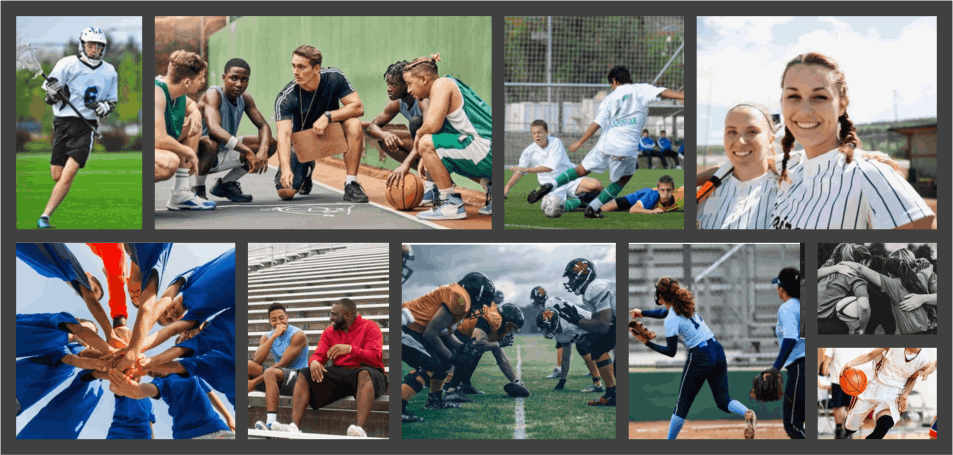
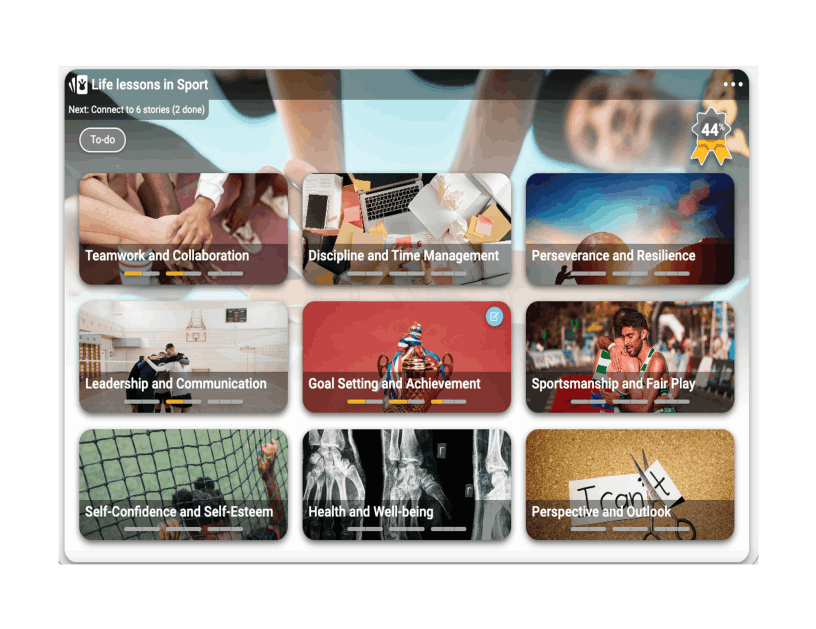
Sports offer more than just physical fitness and entertainment. Engaging in athletic activities as a teenager can provide valuable life lessons that shape character, boost confidence, and lead to life success. Through our app, youth embark on an exciting journey of self-discovery and personal growth.
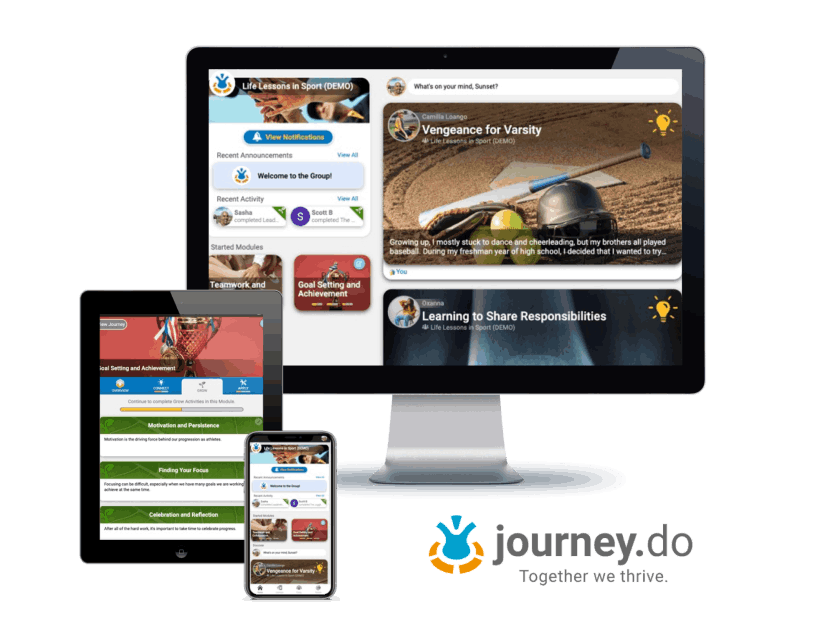
Journey.do is a next generation social growth app, built from the ground up by a team of platform engineers, game designers, and learning scientists to bring about life change. It is strength-based and connects youth to relatable peer stories from your community, as part of a safe and secure small group. Research-based, it uses the power of personal narrative, positive reputation, and applied content to power life change.
The Life Lessons journey was built through interviews with athletes of all ages and combined with development psychology concepts to ensure youth grow in meaningful ways. Youth receive certificates for each journey, and digital portfolios can be created to affirm and support growth. Each journey uses our research-based growth cycle and engages you in 40+ small learning interactions with life coach feedback.
We provide growth as a service, with trained life coaches ready to support your community. All coaches are skilled in providing supportive feedback, and doing so in ways that empowers youth. Coaches are trained on each of the life lessons, and how to support youth in identifying life lessons and to share them in validating ways. Your staff can be as engaged as they wish to be; and we encourage coaches and families to review the final growth reports with youth. .
We built journey.do based on cutting-edge research in the learning sciences on how people learn. Journey.do is a human platform, not simply a content platform.
If we want real-world positive change, content is necessary, but the stories youth create in their lives with that content is more important. Life change happens through action, connection, and reflection.
Research has found that stories can literally rewire brain anatomy. Through stories, people connect in deeply personal ways – affirming possibility and validating change. And through the sharing of story, one person can find their voice and inspire possibility in another.
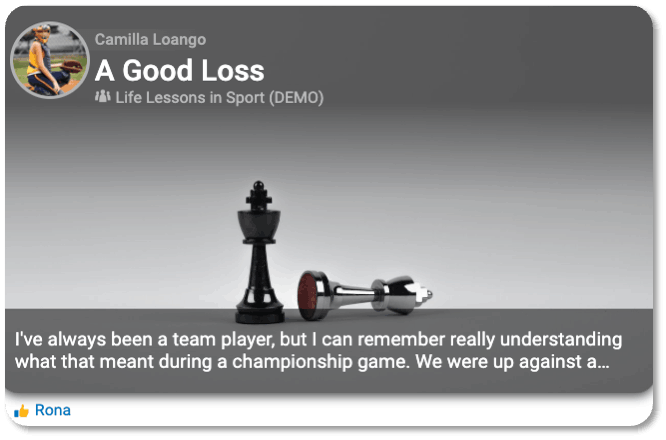
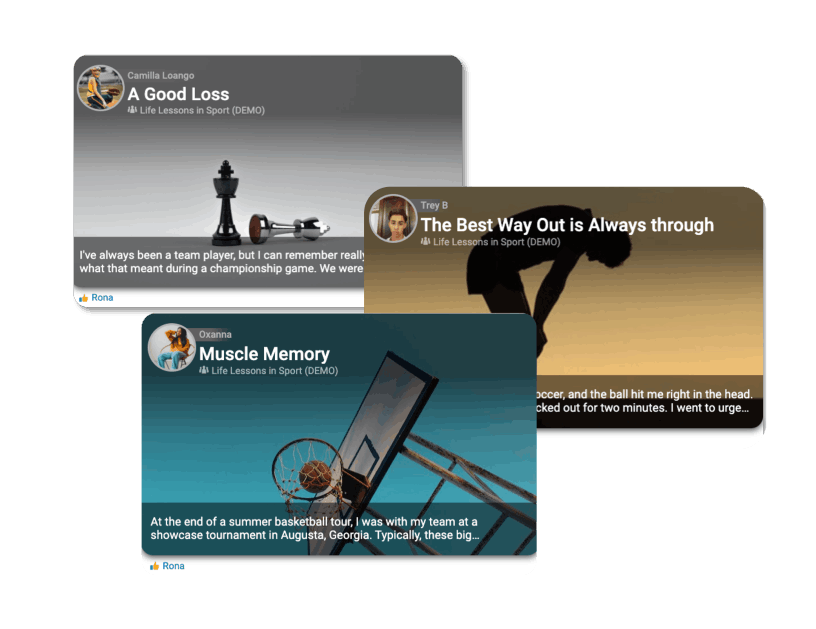
by Camilla
I've always been a team player, but I can remember really understanding what that meant during a championship game. We were up against a team that constantly run-ruled us. We were already counting ourselves out when our coach emphasized how important it was that we communicate, pick each other up, and keep the energy positive in the dugout during this game. She made an analogy with bowling pins, asking us to think about how easy it is for other pins to fall once one does. I thought it was silly at first, but I remembered how defeated I got seeing our pitcher and catcher down and low energy. So I decided to take our coach's advice.
I talked, yelled, and cheered the whole game. There wasn't a quiet moment and it made a huge difference to the whole team. I didn't play particularly well and we lost, but we gave them the best fight we ever had while having fun at the same time. That loss brought us closer as a team and showed us how important it was to think about the whole team and not just ourselves.
This experience taught me that you can always accomplish more when working together with others and have fun while doing it. Doing group projects and learning to get along with my co-workers has been much easier ever since I figured this out and I know it will come in handy as I get older and continue to grow.
Over 30,000 members have logged in to the platform.
Members have shared over 35,000 stories approved by facilitators.
More than 25,000 Certificates have been earned by members.
Members have completed over 100,000 learning activities.
Our facilitators provide life coaching and personalized feedback as youth journey in small groups, and are seen, valued, and validated for their growth. Growth occurs within a mobile-first app with a dynamic feed your organization can use to post related activities alongside our content and community growth, building connected and thriving leagues. We also provide coaches and families growth transcripts, which can be used to discuss key topics with youth and ensure life integration.
We partner with your school coaches to offer a hybrid curriculum, all within a safe and secure growth app that youth can use during school or as part of homework. School coaches and can also produce personalized growth portfolios, along with a growth certificate to validate youth efforts and growth. Growth transcripts can also be provided for families, as part of an extra value-add and youth support.
We partner with your staff to offer after-school growth programming as part of your organizational offerings. We can train your staff or provide feedback from a distance, with staff trained in trauma-informed and strength-based feedback. A dynamic feed allows you to provide other organization announcements, and related resources as part of the youth experience. Printable transcripts can be shared to support meaningful conversations with youth, records of achievements, or to further engage families.
The ASU Global Sport Institute is where diverse disciplines converge to thoughtfully examine critical issues impacting sport. This project is a collaboration between ASU and Lifelab Studios.
With an emphasis on expanding research, sharing knowledge, supporting innovation and advancing education, the institute’s mission is to use sport to create positive change throughout the world. (more at ASU-GlobalSportsInstitute)
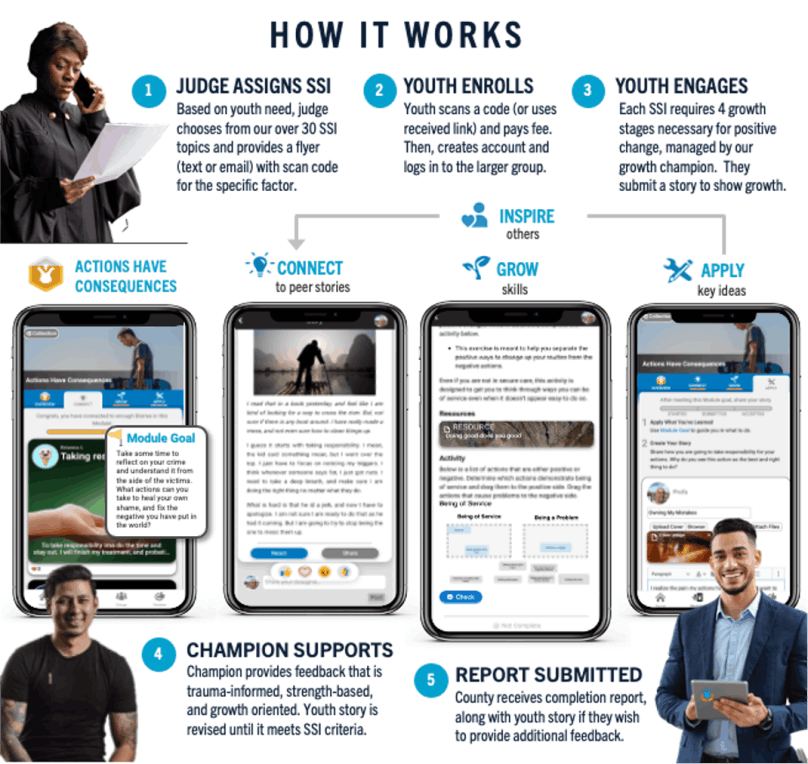
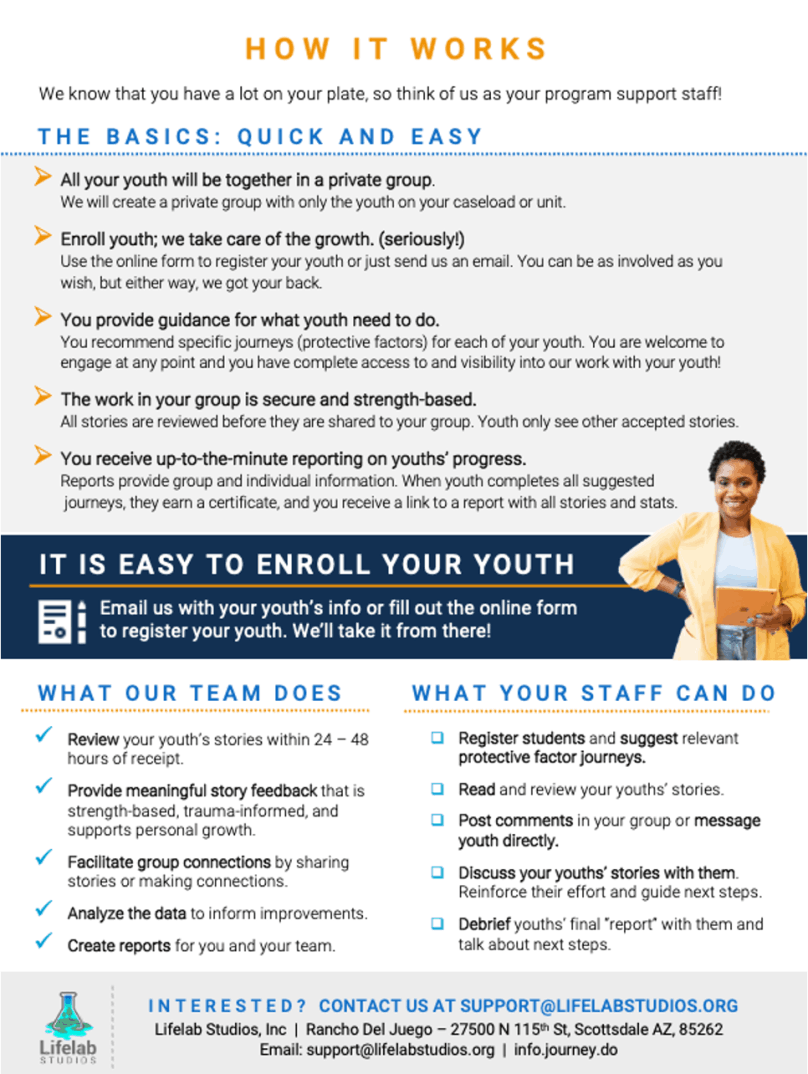
We create small groups within your organization, based on common needs and interests. Youth click on invites to join their private group, and use our apps to grow anytime, anywhere.
Youth login to Journey.do app, connect with peer stories, grow skills, share life stories, get feedback, and earn growth certificate(s). We also provide growth plans and growth portfolios.
Our trained life coaches review stories, provide ongoing progress reports, award protective factor certificates per journey, and generate growth exportable transcripts for each youth.
All coaches are trained to serve your community. They know the Life lessons platform and topics, and are excited to nurture growth.
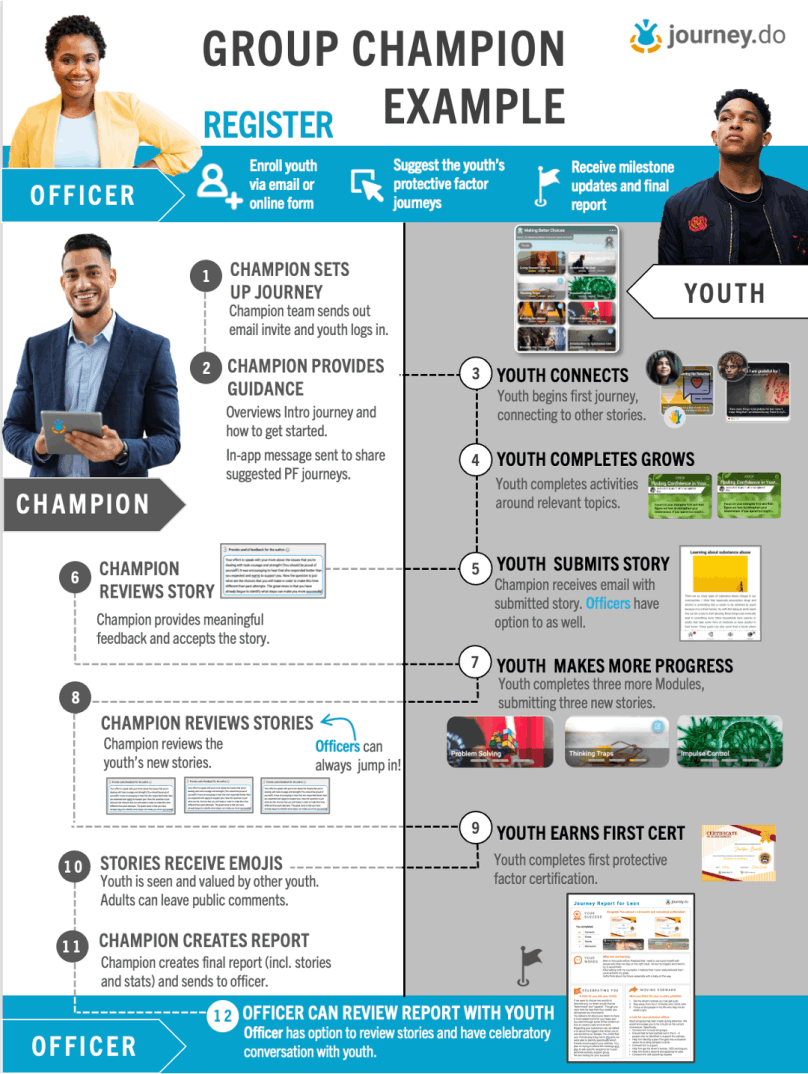
Create a private group to ensure youth are safe and secure; then share a private invite for your community to register.
Administer pre-post surveys to assess personal needs, build authentic motive, and to improve outcomes.
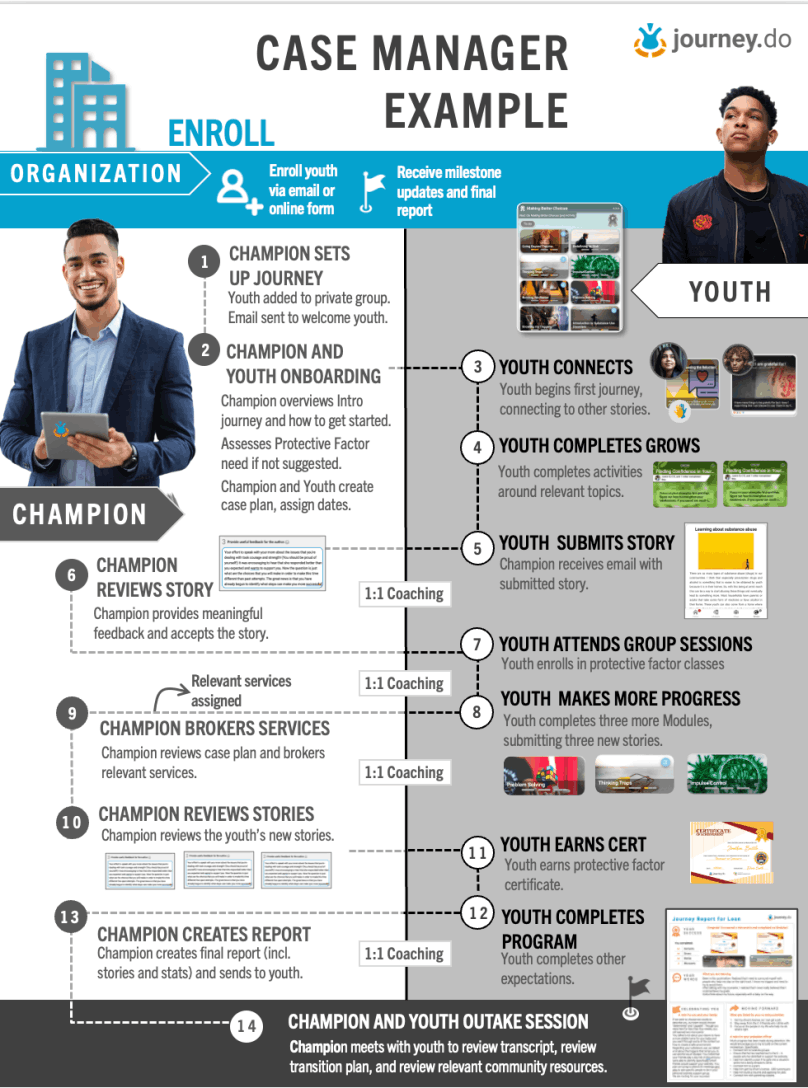
Provide personalized programming and 1:1 coaching if desired; even developing a shareable growth plan.
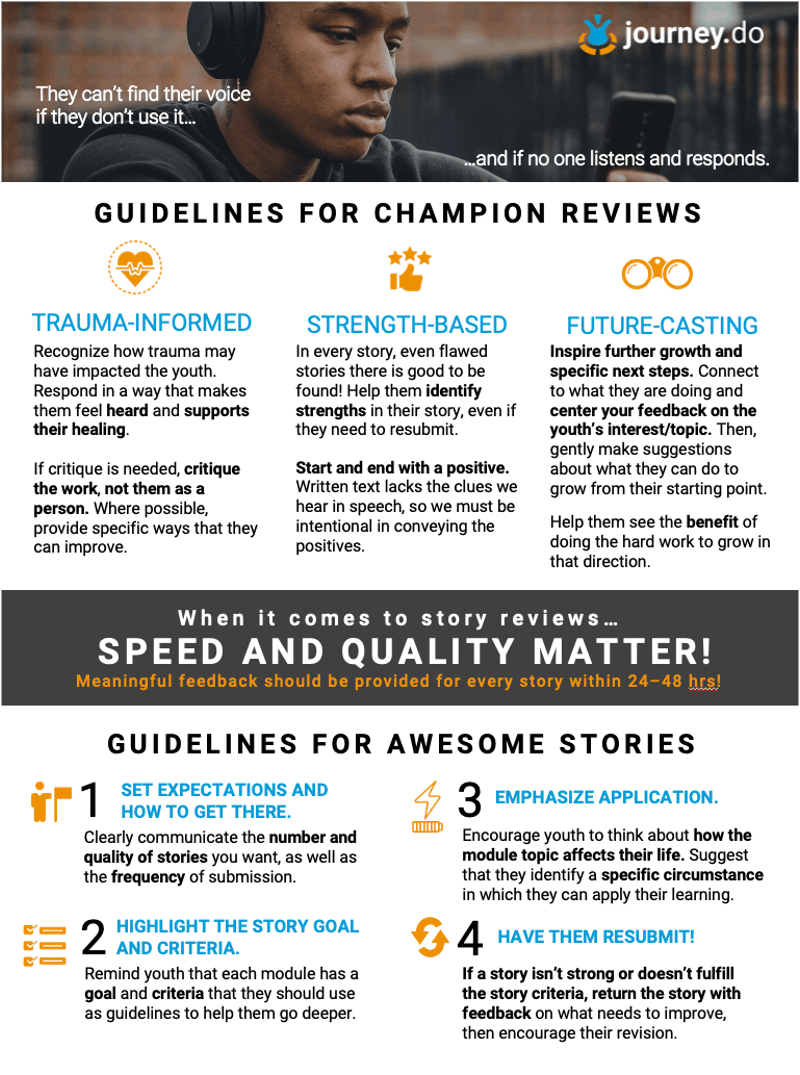
Review stories within 24 – 48 hours of receipt, providing strength-based and growth-oriented feedback.
Facilitate group connections by sharing stories, making connections, celebrating achievements, and adding posts.
Develop personalized growth transcripts, sharing them with youth, coaches, and families to support meaningful growth conversations.
Our solution uses personal transformation, social validation, and life application as incentives to encourage progress. Youth engage with expert content curated to help them reach their goals with reliable and nurturing feedback on their life lessons stories from our trained coaches.
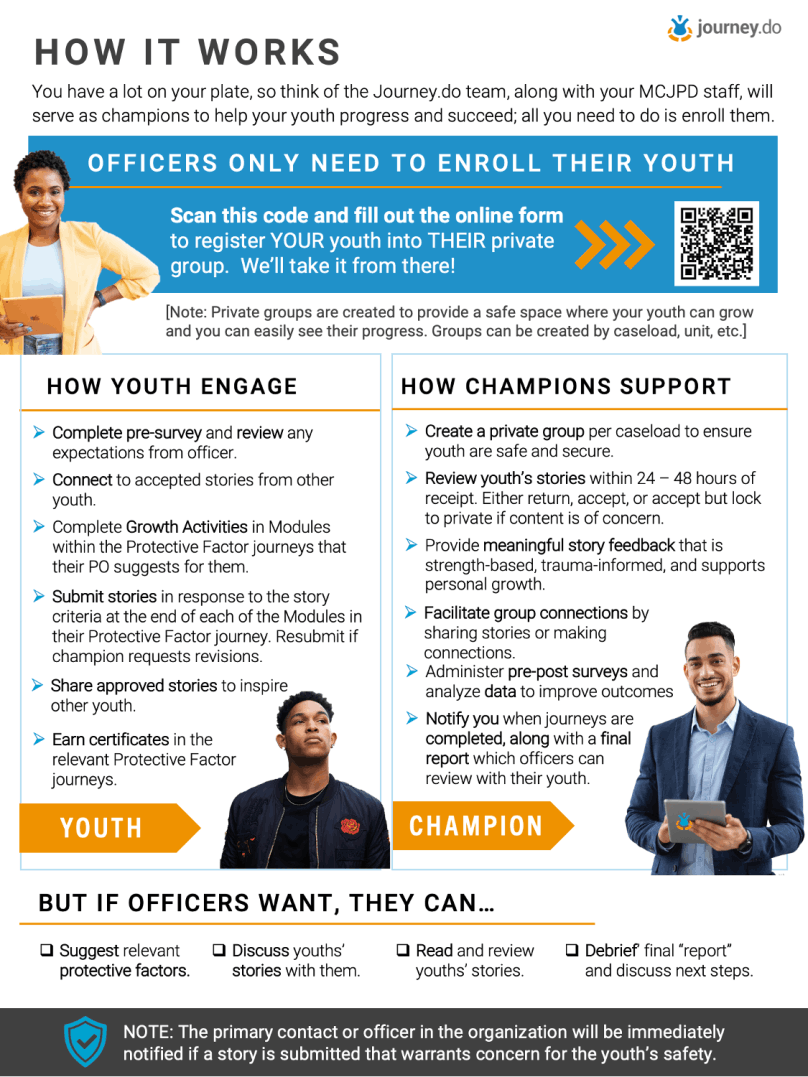
Complete pre-survey, onboarding, and review any expectations or expressed needs.
Read Module goals, and connect to accepted stories from other seniors.
Complete Growth Activities in Modules within the Life Lessons journey that they view as relevant.
Submit stories in response to the story criteria at the end of each of the Modules in their Life Lessons journey. Resubmit if coach requests revisions.
Share approved stories to inspire other youth, and earn social reputation.
Earn certificates that they can add to their resume with local group and ASU branding.
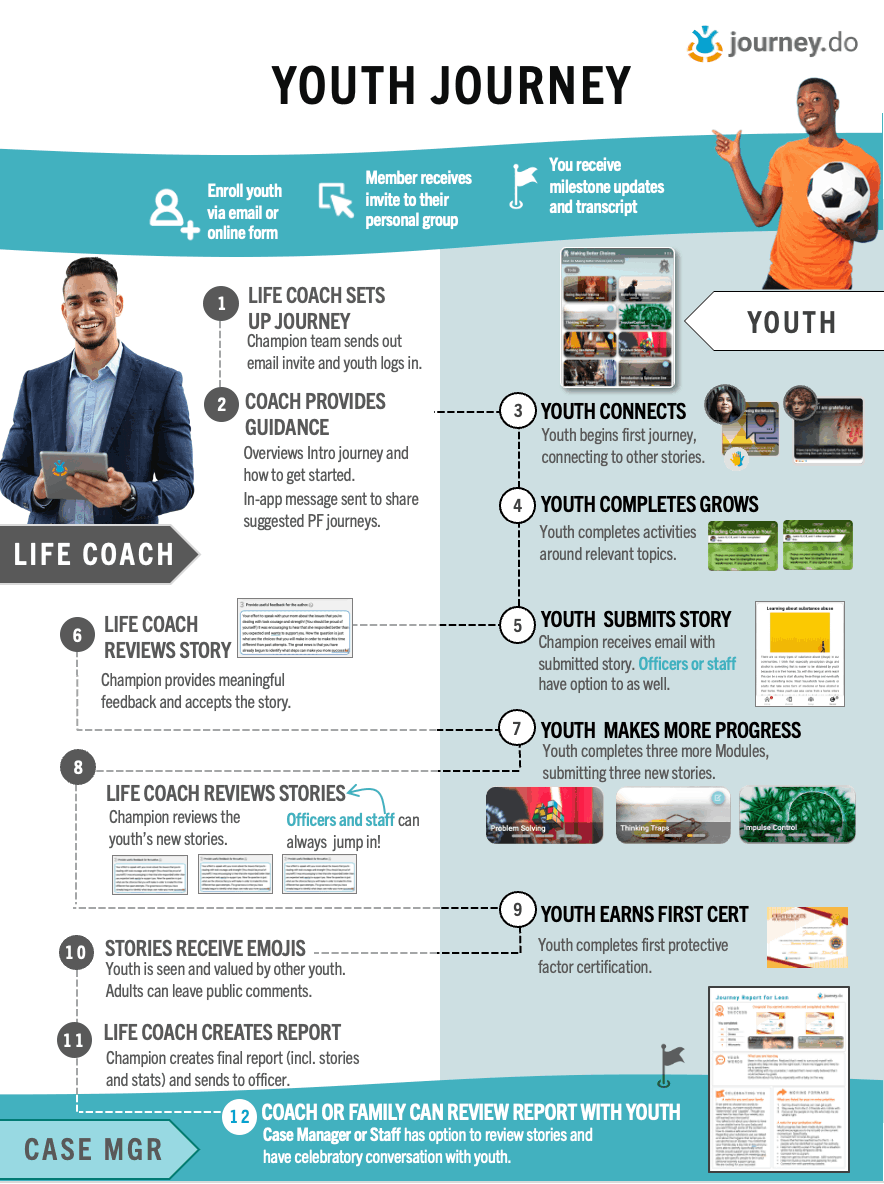
The Managed Journeys package involves us fully managing your groups as youth complete their Life Lessons with support from our certified growth champions. Your staff simply enroll youth. You are notified as members of your community reach milestones, and you receive actionable alerts at key moments if you wish to be more involved in their journey.
The Life Integration package also adds our team doing youth intake, generating a growth plan, providing multiple 1:1 coaching sessions, brokering needed services, and providing a PDF growth transcript for coaches and families. This is appropriate when coaches are busy, or the youth and their families want a little more personal connection.
We provide a Growth Platform solution. This is most appropriate when you organizations have dedicated programming staff. This offering still uses our connected-growth cycle, and can include a shareable growth plan and portfolio. However, local staff are trained and manage growth.
GROWTH PLATFORM
You assign 1-2 Modules, we support growth.
MANAGED JOURNEYS
We manage growth across protective factors.
LIFE INTEGRATION
We provide full case support for youth success.
TRANSITION PLAN
TRANSITION MEETING
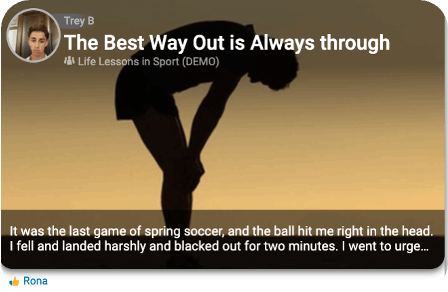
By Trey
It was the last game of spring soccer, and the ball hit me right in the head. I fell and landed harshly and blacked out for two minutes. I went to urgent care straight after and was diagnosed with a severe concussion. I cried and thought this is where my days of playing the sport I loved came to an end. I believed I would never achieve my dreams. I told my parents and coaches and they weren’t certain if I could ever come back to my passion. However, I didn’t want anything more in my life than to play soccer, so I decided to start a hard journey that I knew would come with major challenges.
The doctors said it only took a month to recover, even though it was a severe concussion. I was very happy with this news and thought this journey would be very easy. However, that was not the case. I ended up dealing with this concussion for months and had to quit so I didn’t get permanent brain damage. Eventually, I was diagnosed with post-term concussion syndrome. This means I didn’t recover from the concussion well with concussion-like symptoms for a timeline that can vary from six months to the rest of my life. I was crushed and, eventually, I just wanted to be back in the sport I loved most.
As a result, I played high school soccer, and in every game my head would kill me and I wasn’t allowed to head the ball or even play full contact for part of the season. However, I didn’t care because I loved every second of this season despite the conditions. A year after the concussion, I was finally cured of post-concussion syndrome. I still had migraines as a result of the concussion and have them to this day, but my risk of brain damage is gone. I continued to play soccer and the next high school season I became the captain of the team where I was previously a bench warmer. I learned that no matter how hard it is, the easy way out is never the right one.
Think of Alcoholics Anonymous, group therapy, and Weight Watchers. They all use small groups, with numerous studies illustrating how small groups uniquely promote personal change (Borek & Abraham, 2018; Rosendahl et al. 2021; SAMHSA, 2015). Small groups promote engaged participation and sense of belonging, as well as the power of peers in emphasizing the relatable, real-world struggles of applying what one is learning (Barab & Duffy, 1998; Berg, Landreth, & Fall, 2018; Lave & Wenger, 1991). The value of small groups and communities of practice on growth and learning has been demonstrated through hundreds of studies. (Hattie, 2010).
Meta-analyses have also shown that small-group learning increases academic achievement, improves attitudes towards learning, and increases persistence to completion. (Springer, Stanne, & Donovan, 1999). Another compelling meta-analysis showed that small group learning increases student’s transfer performance – their ability to apply what is learning to another situation. (Pai, Sears, Maeda, 2015).
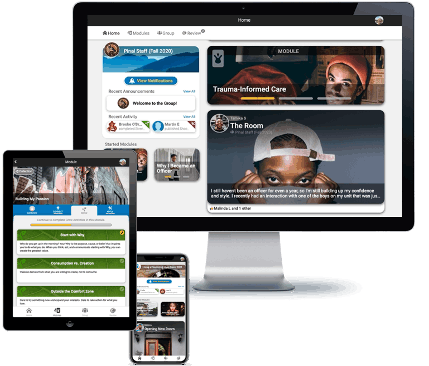
In Journey.do, we provide a social growth platform and app where group leaders support community members in growing capacity to achieve meaningful goals as part of a safe and supportive group where they are seen, valued, and validated for their growth and impact stories.
Research shows that our motivations for learning are central to what we learn. People learn more when knowledge stays connected to what they can do with it (Barab & Duffy, 2012; Cobb & Bowers, 1999; Mclellan, 1996). People are willing to work harder to learn content and skills they see as useful and connected to future goals (Yeager, Walton, & Cohen, 2013), and especially when they are are invested in the outcome (Billett, 1996; Greeno, 1989; Hattie, 2009). When learning starts with “why” content matters, learners have greater personal investment, knowledge application, and show higher skills development (Bransford, Brown, & Cocking, 2002; Sawyer, 2022).
People learn better when they are interested, curious, passionate, engaged, pursuing goals that matter to their life (Bransford, Brown, & Cocking, 2000; CTGV, 1991/1993; Immordino-Yang & Faeth, 2010). We need to reframe content around its real-world value. If the goal of learning is to enable people to function in the world, then we need to engage them in those tasks as part of the learning process (Engle, 2006; Gresalfi & Barab, 2011).
In Journey.do, each Module is positioned as a goal, beginning with a statement of real-world importance, providing connection to real-world stories, and the expectation of applying what one is learning, with each achievement being a step along the journey.
Stories connect and persuade us, affecting us in deeply emotional ways. Stories provide a means of sharing history, tacit knowledge, critical thinking, important details, and even specific skills for succeeding in real-world situations (Bruner, 2002; Gray, 2009; Gottschall, 2012). Stories are personal, contextual, and relational, affirming possibility, reinforcing identity, and validating transformation (Barab, Dodge, Ingram-Goble, Pettyjohn, Peppler, & Solomou, 2010). Even anonymous story-telling among peers showed mental health benefits (Collins, Arbour, et al., 2022). Stories create an opportunity to rewrite those narratives of self (Kenyon & Randall, 1997; Mclean, Pasupathi, & Pals, 2007).
Sharing personal stories reinforces and gives value to diverse voices and unique identities, which when valued creates a sense of “rightful presence, central for people to feel like they belong, that they matter, and their voice counts (Barton and Tan, 2020). Stories connect us to other people, affirming our personal struggle and recognizing our successes(Sackstein, 2017). Recent neuroscience research has found that when someone reflects on key lessons to be learned from stories, they can form new neuronal connections; thereby, expanding connections in their brains (Immordino-Yang & Knecht, 2020).
In Journey.do, stories are a key value-proposition, providing a useful means of articulating growth, an impetus for engaging in learning (as members connect with each other’s story while aspiring to create their own), and are considered part of the knowledge the platform provides.
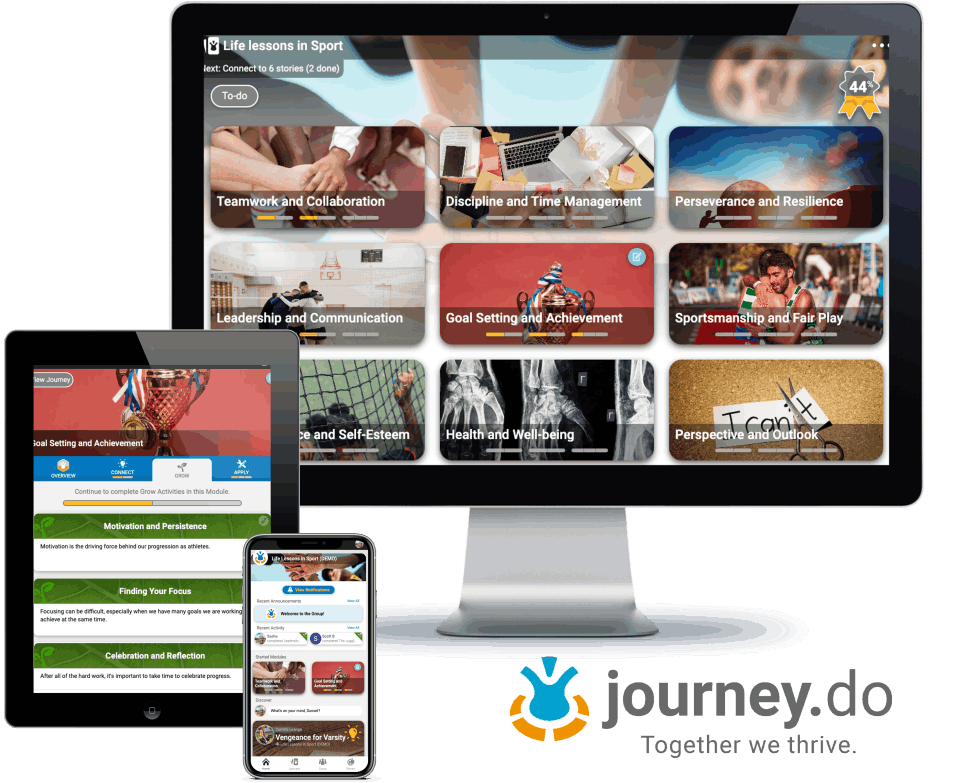
Several research studies have examined the value of life lessons obtained through sports participation among children and adolescents. Eime et al. (2013) conducted a systematic review, revealing the psychological and social benefits of engaging in sports for young individuals. The findings highlighted the role of sports in character development, fostering resilience, and promoting a positive mindset. Similarly, Camiré and Trudel (2010) explored high school athletes' perspectives on character development through sports, emphasizing how participation in sports cultivates essential life skills such as leadership, discipline, and teamwork. Additionally, Côté and Gilbert (2009) emphasized the significance of effective coaching in promoting life lessons and character development in young athletes, thereby enhancing the overall impact of sports on youth development. Gould and Carson (2008) also discussed the potential benefits and future prospects of life skills development through sports, stressing the importance of sports in shaping positive character traits and life skills in young individuals.
African American and European American youth have also been studied in terms of the developmental benefits of sports and extracurricular activities. Fredricks and Eccles (2008) conducted research on the participation in extracurricular activities among these groups, finding that engaging in sports positively impacted the character and life skills of both African American and European American youth. These studies collectively support the notion that sports play a crucial role in imparting valuable life lessons to young individuals, including resilience, teamwork, discipline, and leadership. By understanding the significance of these findings, educators, parents, and coaches can better facilitate youth sports experiences and leverage their potential to promote character development and life success.
Champions propel learning in unique ways by: Setting up conditions to maximize learning by building a safe community with successful cohorts (Borders, 1991; Frei & Morris, 2020); Creating a sense of group culture and mood(Sy, Côté, & Saavedra, 2005); Providing personalized direction and setting relevant goals (Cloud & Townsend, 2010; Roth, 1986); Offering rich feedback in a personal and supportive manner (Hattie, 2009); Introducing relevant knowledge (Kivlighan & Dennis, 2010); Facilitating conversations and useful member connections (Morrison, 2002). Champions operate in ways similar to coaches, with a deep focus on ways that ensure each youth is making progress on there unique journeys. Their goal is to be supportive, inspirational, and provide critical feedback to ensure youth are growing with a balance between feedback that is trauma-informed, strength-based, and inviting youth to expand their thinking in ways that go beyond simply validating where they are if an opportunity for further growth exists.
In a synthesis of over 900 meta-analyses, feedback was found to be one of the most powerful influences on learning and achievement, especially when targeted towards personally-valued goals, was delivered in a manner that is strength-based and was designed to improve performance—rather than simply stating that they got it right or wrong (Hattie & Timperley, 2007; Hattie, 2009). People are more willing to grow when they feel seen and valued for where they are, even as they are invited to grow into a new possibility. Peers can become champions over time. They are often perceived as less judgmental than experts, an provide insights about the struggles in practice that facilitators might not, and “Speak the same language” (Borders, 1991; Ladyshewsky 2006; Secomb 2008).
In Journey.do, we offer a range of services to ensure that every member is supported by a strong champion, who dynamically engages learners, provides rich feedback, personalizes trajectories, and facilitates asset-based conversations and impact across the small group journeys.
Trauma-Informed Care is an approach to supporting youth that recognizes the impact of trauma and prevalence of adversity that youth have experienced and aims to respond in a way that avoids re-traumatization and promotes healing (Bent-Goodley, 2019; Yatchmenoff, Sundbork, & Davis, 2017). This approach is centered on the principles of safety, choice, collaboration, and empowerment and involves communicating in a manner that avoids inadvertently repeating unhealthy interpersonal dynamics in the helping relationship (Knight, 2015; Levenson, 2017). The Substance Abuse and Mental Health Services Administration (SAMHSA, 2019) has provided a comprehensive guide to trauma-informed care that involves (a) realizing the widespread impact of trauma, (b) recognizing the signs and symptoms of trauma, (c) responding by fully integrating knowledge about trauma into interactions, and (d) seeking to actively resist re-traumatization by providing feedback that is safe, supportive, and empowering.
Strength-based feedback is a type of feedback that focuses on highlighting a person's strengths, abilities, and positive qualities, rather than solely focusing on their weaknesses or areas for improvement (Brough, Bond, & Hunt, 2004; Rashid, 2015). This type of feedback aims to build on a person's strengths and create a supportive, growth-oriented environment, rather than one that is solely critical and negative. By recognizing and building on the positive aspects of an individual, strength-based feedback can help promote confidence, resilience, and motivation (Hammond, 2010; Xie, 2013). Strength-based feedback should involve specific and concrete examples of the individual's strengths in action with feedback that encourages the individual to continue to build on their strengths and positive qualities (Laursen, 2000).
In Journey.do, champions are trained to provide feedback that is trauma-informed and strength-based. At the same time they hold high expectations, ensuring youth are addressing the story criteria and feedback will often invite the learner to engage all areas of the Module as they consider future possibilities often in a story revision.